Thursday, March 8, 2007

Two practice midterms

In section tomorrow we will be working through not only key points on the Chart o' Poets, but also a few entries on a poetry-only practice midterm. For the last fifteen minutes of discussion tomorrow, I am going to ask you to name two poems you would like to discuss -- poems that baffle you, or that we haven't had a chance to discuss yet, or just poems you'd like a chance to talk about some more.

I have also put together a second practice midterm involving a mix of poetry and Middlemarch. This might be a useful tool to spur studying over the weekend. There are a couple different ways you might use it:
  1. To figure out areas where you are weak -- if it turns out you can't identify any of the second-generation Romantics, then that tells you to spend more time with Keats and Shelley
  2. As fodder for discussion with a study group or a study partner, to talk through all the nuances of the texts we've encountered over the last month and a half; chances are that if you didn't understand what was going on in "Elgin Marbles" someone else did and would be willing to talk it through
  3. To practice answering those devilishly picky prompts in Part I: once you've written out explanations of the thematic significance of six Middlemarch passages, you'll probably have gotten the hang of it

Friday, March 2, 2007

Hebdomadal topics (week 7)

Yesterday, Prof. Ortiz-Robles gave an example of the sort of question he will be asking for Part II of the midterm: "Discuss the relationship between history and memory with reference to textual details from one of the passages in Part I." (At least, that what I had copied down in my notes.)

For this hebdomadal, develop a similarly open thematic question that you think could be asked of almost any text we've read this semester. This means looking back through your notes and pulling out the conceptual problems Prof. Ortiz-Robles has returned to several times in his lectures.

When you craft the question, you might want to be more specific than asking about "the relationship" between Concept 1 and Concept 2, but don't feel that you have to be two too specific -- asking how Concept 1 shapes Concept 2 might be enough detail to get you going. (Other good verbs: reveals, limits, creates.)

After you've done this, quote a short passage from the poem about which you feel least comfortable and use this passage to answer the essay question you've created. (Poems only this week.)

If I don't drown in grading next week, I'll post the essay topics you guys come up with so you have some likely essay prompts with which to study.

[Thank you, anonymous commenter!]

Charting the Romantics and Victorians

As promised, here is a link to a Word .doc of the chart I handed out in class:
Try to fill out columns for two poets, one Romantic and one Victorian. (Recommendation: tackle the two poets about whom you feel least knowledgeable.)

Spend the most time answering the thematic questions posed by the chart: the poets' thematic interests in the individual, society, nature, and poetry itself. If you go in to the midterm with for solid thematic questions that apply to each poet, you'll pretty much have the IDs nailed.

Tuesday, February 27, 2007

Of Keats and his cats

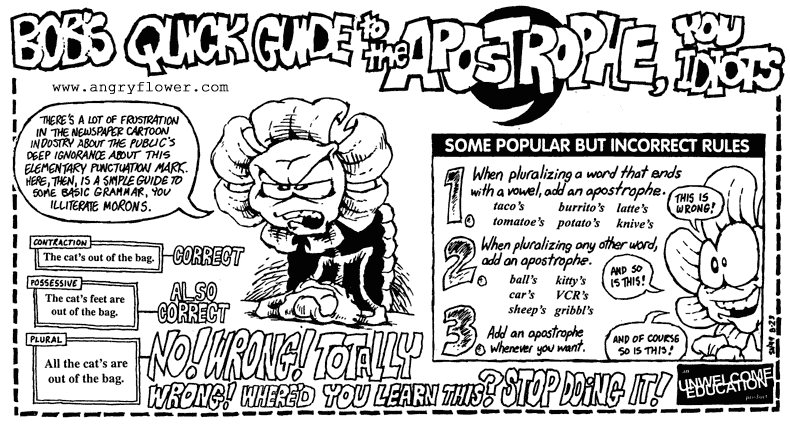
When forming a possessive to a singular noun in English, you almost without exception add 's: the cat's hats, etc. This rule applies whether or not the singular noun in question concludes with an s; hence, if we were interested in the feline companions of John Keats we would write about Keats's cats. (If we were interested in the cephaliclyptic arrangements of his feline companion, we would write about Keats's cat's hats. This could be the beginning of a peculiarly Seussian bit of literary analysis.)

Although you should never site Wikipedia as a source for anything, I will use it this time as a source for a list of more reputable sources that make this claim (including the MLA Handbook and The Elements of Style). If these aren't sufficiently authoritative sources for you, I direct you to Bob the Angry Flower's remarks on this topic.

Quiz on Friday!

There will be a quiz on Middlemarch in discussion this Friday. I will expect you to have worked through to the end of Book V. Remember, you can find examples of strong answers to the quiz here and here.

Hebdomadal topics (week 6) (Updated 2/27)

If one of the hebdomadal topics from last week caught your eye, feel free to tackle it! You might particularly consider last week's prompt about allusions in light of the question Kelly (305) raised in lecture today: why does GE anachronistically refer (two or three times) to an "Italian with white mice" -- that is, to Count Fosco from Wilkie Collins's The Woman in White? What does it mean that GE is referring, almost in the same chapter, to the great authors of western literature (Dante, Shakespeare) and to a contemporary writer of detective stories?

Topic 1: Speech and structure in Middlemarch
In lecture today, Prof. Ortiz-Robles worked out how promises structure social and moral development in Middlemarch. In your hebdomadal, work through how a different kind of speech reveals the structural and ethical underpinnings of the text. Some possibilities:
  • Gossip (e.g. about Lydgate: ch. XLV, pp. 273-284)
  • Threat (e.g. Raffles, pp. 328ff)
  • Newspaper editorializing (e.g. about Brooke, p. 239)
  • Flirtation (pretty much any time Rosamond speaks, e.g. pp. 270f)
  • Reading aloud (e.g. Trumbull butchering Anne of Geierstein, pp. 196-7)
  • Drunken abuse (e.g. pp. 246ff)
(Frankly, I'm most excited about gossip: it has the advantage not merely of concrete social effect, but it also has some of the titillation of drunken abuse.)
Topic 2: Painting and zookeeping in Middlemarch
I remain fascinated by how incongruously GE deploys symbolic effects in Middlemarch alongside brutal realism. There are probably a thousand sustained images in the novel, but here are two that trouble me:
  • Animals are nearly everywhere. (One particularly striking example: on p. 283, Lydgate is called "an emotional elephant.")
  • Pictures
    • 137ff: DB and EC painted in Rome
    • 151: Horrock looks "as if he had been a portrait by a great master"
    • 205-6: EC as Thomas Aquainas
    • 246: Dagley's cottage "would have made a sort of picture"
    • 253: Mary and Letty "made a pretty picture in the western light"
In your hebdomadal, use the analysis of one of these symbols to revisit our broad question from two weeks ago: what is the role of symbolic language in a realistic novel? Is Middlemarch itself a kind of picture -- and, if so, what does that mean? Why would that be significant? Are the Middlemarchers of the book all animals of a sort? Why is that important?

(Jenna [306] prompted the second part of this question with her hebdomadal last week. Thanks, Jenna!)

Sunday, February 25, 2007

What should we discuss next?

As I mentioned on Friday, I'm looking to make the two discussions before the midterm as useful as possible for you. My current plan looks like this:
  • 3/2: Looking for thematic trajectories in the first five books of Middlemarch
  • 3/9: Thematic comparison of all seven poets

If you would rather concentrate on a specific book or passage from Middlemarch, or a specific poet, or a specific poem, let me know! If you feel relatively confident with Middlemarch and would like to spend the next two weeks on the poets, that's an option too.

If you have a request or an idea, please shoot me an email or post a comment! If you comment, please at least give your section number so I can develop different lesson plans if section 305 wants Middlemarch and 306 wants the Romantics. (On the advice of a previous commenter I've disabled moderation, so you should be able to post speedily. Try to keep the snark to a minimum, though.)

Robert Browning, Baldessarre Galuppi, and Kris Delmhorst

Kris Delmhorst's most recent album, Strange Conversation, opens with a catchy track called Galuppi Baldassare, in which Delmhorst sets Robert Browning's "A Toccata of Galuppi's" to music and add conversational lines of her own. You can download the track (and a few others from the same album) at Womenfolk.net. (Baldassarre Galuppi was a Venetian composer of mainly underwhelming tinkly parlor music.) This interrelationship of music, poetry, and place fascinates me: what Browning's speaker gets from Galuppi's toccata seems worlds different from what Delmhost gets from Browning's poem.

Wednesday, February 21, 2007

Quiz scoring and answers

Hi, all! Here is how quiz scoring worked: I expected an average grade of 6. (The actual average was 6.2) Quizzes that scored 6/10 neither add nor subtract points from your final class grade. Quizzes that scored above 6 add points to your final class grade: a 7/10 gives +0.5 points, an 8/10 gives +1.0, a 9/10 gives +1.5, and a 10/10 gives +2.0. Quizzes that scored below 6 subtract points from your final class grade: 5/10 gives -0.33, 4/10 gives -0.67, 3/10 gives -1.0, and 2/10 gives -1.33.

That is how quizzes will be graded in the future, with a maximum benefit or penalty of 2 points. The expected average might shift up from a 6 to a 7 a little bit later in the semester, however.

Average grades on the two parts of the quiz were 2.6/4 for context and 3.9/6 for thematic significance. The thematic significance part of these IDs is especially difficult, I think, because we have all been trained to think about significance in the text but not about significance for the text. Here are two examples of quizzes that gave strong, articulate considerations of the thematic significance of this passage for the text:

Jenna (306) wrote
I think that the quotations encompass Eliot's larger argument about marriage. She refers to the heart's desires as a "tide" where things "come and go." If our heart's desires are not consistent, but they are "running mesengers" to our heads, how can we make a decision of permanence like marriage? Marriage is a bond for life; however, Eliot makes it clear that our feelings contradict this certainty.
Emily A. (306) wrote
The line that stood out right away was that when people go on a long journey, they "get tired to death of each other." I think this line ties the name of the book (Waiting for Death) to Dorothea and Casaubon, portending the death of their marriage. This scene also draws on the idea of web of affinities in Middlemarch -- Mrs. Cadwallader's connection to everyone, how her words can affect Dorothea in spite of a strong relationship. Celia's blushing is significant to the passage...sets up a contrast between the sisters -- Celia is always calm and rational, we see a contrast in Dorothea.

Tuesday, February 20, 2007

Some notes on themes

Friday's quizzes were still a bit weak, mainly in part c: identify the thematic significance of this passage...

A theme, remember, is a recurring question or problem in a text. You could say that a theme is what a text is about. Themes shouldn't be vague: for example, "marriage" is not a theme but a concept. If you ask questions about that concept, you might come closer to a thematic preoccupation of Middlemarch; for example, you might say that one theme of the novel is the role played by marriage in connecting the individual to his or her social obligations. This could be phrased as a question: when Dorothea and Rosamond get married, how do their relationships to their premarital social networks change? This could be phrased as a problem: what role does marriage play in reinforcing artificial social structures that are more in need of reform than of reaffirmation?

No text is about only one thing, so there is lots of flexibility here: thinking just about the concept of marriage in Middlemarch we can see that it touches on dozens of thematic questions and problems:

  1. What role does marriage play in undermining or reinforcing individual agency?
  2. How does marriage reveal the power differential between men and women in Middlemarch?
  3. How does marriage shape our understanding of personal history? (For example, how do we see Lydgate's failed pursuit of Laure once he is married to Rosamond?)
  4. How is marriage produced? (This was the subject of Prof. Ortiz-Robles's lecture last Tuesday.)
  5. What role does marriage play in the social network?
  6. How does marriage undermine -- or how is it undermined by -- the web of affinities that span across or between marriages? (E.g. Dorothea and Will, or Lydgate and Farebrother.)
  7. How does marriage change our understanding of class dynamics? (Consider the number of cross-class marriages that pre-exist in the text: the Vincys, the Cadwalladers, the Garths.)

Last semester, my students pointed me toward a fairly straightforward trick for transforming a wide concept ("marriage" or "class") into a narrow theme: connect one concept to another ("How does marriage explain class change or class reform?").

Every paper, hebdomadal, quiz and exam essay you write must demonstrate your familiarity with thematic analysis: you should be able to connect nearly any sentence from Middlemarch or nearly any line from "In Memoriam" to a theme from that text. Your paper due this Friday is, in essence, an exploration of a single textual theme or -- in some cases -- an exploration of themes from two texts that connect together. To be able to write articulately about a text, you should be able to say what that text is about -- or, at least, one problem that text is trying to solve.