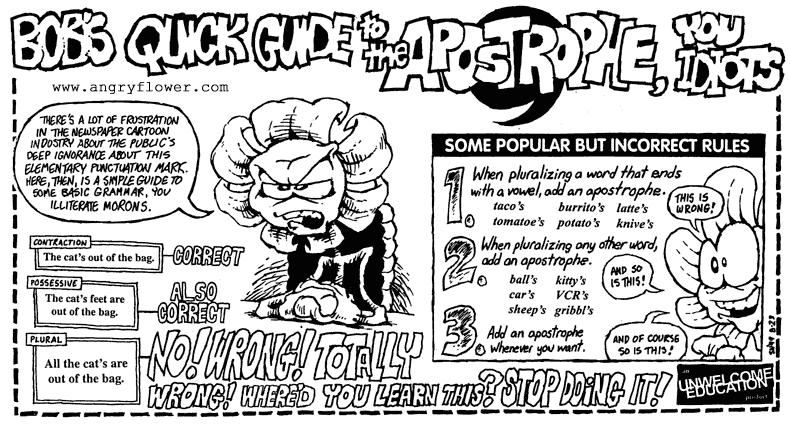
When forming a possessive to a singular noun in English, you almost without exception add 's: the cat's hats, etc. This rule applies whether or not the singular noun in question concludes with an s; hence, if we were interested in the feline companions of John Keats we would write about Keats's cats. (If we were interested in the cephaliclyptic arrangements of his feline companion, we would write about Keats's cat's hats. This could be the beginning of a peculiarly Seussian bit of literary analysis.)
Although you should never site Wikipedia as a source for anything, I will use it this time as a source for a list of more reputable sources that make this claim (including the MLA Handbook and The Elements of Style). If these aren't sufficiently authoritative sources for you, I direct you to Bob the Angry Flower's remarks on this topic.
Tuesday, February 27, 2007

Quiz on Friday!
Hebdomadal topics (week 6) (Updated 2/27)
If one of the hebdomadal topics from last week caught your eye, feel free to tackle it! You might particularly consider last week's prompt about allusions in light of the question Kelly (305) raised in lecture today: why does GE anachronistically refer (two or three times) to an "Italian with white mice" -- that is, to Count Fosco from Wilkie Collins's The Woman in White? What does it mean that GE is referring, almost in the same chapter, to the great authors of western literature (Dante, Shakespeare) and to a contemporary writer of detective stories?
Topic 1: Speech and structure in Middlemarch
Topic 1: Speech and structure in Middlemarch
In lecture today, Prof. Ortiz-Robles worked out how promises structure social and moral development in Middlemarch. In your hebdomadal, work through how a different kind of speech reveals the structural and ethical underpinnings of the text. Some possibilities:Topic 2: Painting and zookeeping in Middlemarch(Frankly, I'm most excited about gossip: it has the advantage not merely of concrete social effect, but it also has some of the titillation of drunken abuse.)
- Gossip (e.g. about Lydgate: ch. XLV, pp. 273-284)
- Threat (e.g. Raffles, pp. 328ff)
- Newspaper editorializing (e.g. about Brooke, p. 239)
- Flirtation (pretty much any time Rosamond speaks, e.g. pp. 270f)
- Reading aloud (e.g. Trumbull butchering Anne of Geierstein, pp. 196-7)
- Drunken abuse (e.g. pp. 246ff)
I remain fascinated by how incongruously GE deploys symbolic effects in Middlemarch alongside brutal realism. There are probably a thousand sustained images in the novel, but here are two that trouble me:In your hebdomadal, use the analysis of one of these symbols to revisit our broad question from two weeks ago: what is the role of symbolic language in a realistic novel? Is Middlemarch itself a kind of picture -- and, if so, what does that mean? Why would that be significant? Are the Middlemarchers of the book all animals of a sort? Why is that important?
- Animals are nearly everywhere. (One particularly striking example: on p. 283, Lydgate is called "an emotional elephant.")
- Pictures
- 137ff: DB and EC painted in Rome
- 151: Horrock looks "as if he had been a portrait by a great master"
- 205-6: EC as Thomas Aquainas
- 246: Dagley's cottage "would have made a sort of picture"
- 253: Mary and Letty "made a pretty picture in the western light"
(Jenna [306] prompted the second part of this question with her hebdomadal last week. Thanks, Jenna!)
Sunday, February 25, 2007
What should we discuss next?
As I mentioned on Friday, I'm looking to make the two discussions before the midterm as useful as possible for you. My current plan looks like this:
- 3/2: Looking for thematic trajectories in the first five books of Middlemarch
- 3/9: Thematic comparison of all seven poets
If you would rather concentrate on a specific book or passage from Middlemarch, or a specific poet, or a specific poem, let me know! If you feel relatively confident with Middlemarch and would like to spend the next two weeks on the poets, that's an option too.
If you have a request or an idea, please shoot me an email or post a comment! If you comment, please at least give your section number so I can develop different lesson plans if section 305 wants Middlemarch and 306 wants the Romantics. (On the advice of a previous commenter I've disabled moderation, so you should be able to post speedily. Try to keep the snark to a minimum, though.)
Robert Browning, Baldessarre Galuppi, and Kris Delmhorst
Kris Delmhorst's most recent album, Strange Conversation, opens with a catchy track called Galuppi Baldassare, in which Delmhorst sets Robert Browning's "A Toccata of Galuppi's" to music and add conversational lines of her own. You can download the track (and a few others from the same album) at Womenfolk.net. (Baldassarre Galuppi was a Venetian composer of mainly underwhelming tinkly parlor music.) This interrelationship of music, poetry, and place fascinates me: what Browning's speaker gets from Galuppi's toccata seems worlds different from what Delmhost gets from Browning's poem.
Wednesday, February 21, 2007
Quiz scoring and answers
Hi, all! Here is how quiz scoring worked: I expected an average grade of 6. (The actual average was 6.2) Quizzes that scored 6/10 neither add nor subtract points from your final class grade. Quizzes that scored above 6 add points to your final class grade: a 7/10 gives +0.5 points, an 8/10 gives +1.0, a 9/10 gives +1.5, and a 10/10 gives +2.0. Quizzes that scored below 6 subtract points from your final class grade: 5/10 gives -0.33, 4/10 gives -0.67, 3/10 gives -1.0, and 2/10 gives -1.33.
That is how quizzes will be graded in the future, with a maximum benefit or penalty of 2 points. The expected average might shift up from a 6 to a 7 a little bit later in the semester, however.
Average grades on the two parts of the quiz were 2.6/4 for context and 3.9/6 for thematic significance. The thematic significance part of these IDs is especially difficult, I think, because we have all been trained to think about significance in the text but not about significance for the text. Here are two examples of quizzes that gave strong, articulate considerations of the thematic significance of this passage for the text:
Jenna (306) wrote
That is how quizzes will be graded in the future, with a maximum benefit or penalty of 2 points. The expected average might shift up from a 6 to a 7 a little bit later in the semester, however.
Average grades on the two parts of the quiz were 2.6/4 for context and 3.9/6 for thematic significance. The thematic significance part of these IDs is especially difficult, I think, because we have all been trained to think about significance in the text but not about significance for the text. Here are two examples of quizzes that gave strong, articulate considerations of the thematic significance of this passage for the text:
Jenna (306) wrote
I think that the quotations encompass Eliot's larger argument about marriage. She refers to the heart's desires as a "tide" where things "come and go." If our heart's desires are not consistent, but they are "running mesengers" to our heads, how can we make a decision of permanence like marriage? Marriage is a bond for life; however, Eliot makes it clear that our feelings contradict this certainty.Emily A. (306) wrote
The line that stood out right away was that when people go on a long journey, they "get tired to death of each other." I think this line ties the name of the book (Waiting for Death) to Dorothea and Casaubon, portending the death of their marriage. This scene also draws on the idea of web of affinities in Middlemarch -- Mrs. Cadwallader's connection to everyone, how her words can affect Dorothea in spite of a strong relationship. Celia's blushing is significant to the passage...sets up a contrast between the sisters -- Celia is always calm and rational, we see a contrast in Dorothea.
Tuesday, February 20, 2007
Some notes on themes
Friday's quizzes were still a bit weak, mainly in part c: identify the thematic significance of this passage...
A theme, remember, is a recurring question or problem in a text. You could say that a theme is what a text is about. Themes shouldn't be vague: for example, "marriage" is not a theme but a concept. If you ask questions about that concept, you might come closer to a thematic preoccupation of Middlemarch; for example, you might say that one theme of the novel is the role played by marriage in connecting the individual to his or her social obligations. This could be phrased as a question: when Dorothea and Rosamond get married, how do their relationships to their premarital social networks change? This could be phrased as a problem: what role does marriage play in reinforcing artificial social structures that are more in need of reform than of reaffirmation?
No text is about only one thing, so there is lots of flexibility here: thinking just about the concept of marriage in Middlemarch we can see that it touches on dozens of thematic questions and problems:
- What role does marriage play in undermining or reinforcing individual agency?
- How does marriage reveal the power differential between men and women in Middlemarch?
- How does marriage shape our understanding of personal history? (For example, how do we see Lydgate's failed pursuit of Laure once he is married to Rosamond?)
- How is marriage produced? (This was the subject of Prof. Ortiz-Robles's lecture last Tuesday.)
- What role does marriage play in the social network?
- How does marriage undermine -- or how is it undermined by -- the web of affinities that span across or between marriages? (E.g. Dorothea and Will, or Lydgate and Farebrother.)
- How does marriage change our understanding of class dynamics? (Consider the number of cross-class marriages that pre-exist in the text: the Vincys, the Cadwalladers, the Garths.)
Last semester, my students pointed me toward a fairly straightforward trick for transforming a wide concept ("marriage" or "class") into a narrow theme: connect one concept to another ("How does marriage explain class change or class reform?").
Every paper, hebdomadal, quiz and exam essay you write must demonstrate your familiarity with thematic analysis: you should be able to connect nearly any sentence from Middlemarch or nearly any line from "In Memoriam" to a theme from that text. Your paper due this Friday is, in essence, an exploration of a single textual theme or -- in some cases -- an exploration of themes from two texts that connect together. To be able to write articulately about a text, you should be able to say what that text is about -- or, at least, one problem that text is trying to solve.
Friday, February 16, 2007
Hebdomadal (week 5)
There is some logic to writing an extra one or two pages of literary analysis the same week you have a high-stakes essay due: you can think of these prompts as intellectual appetizers to the meatier course of your first essays. You can continue to test the limits of your analytical prowess in a low-stakes hebdomadal, taking risks in your argument here to practice ways of taking risks in the longer argument of your essay. A tantalizing, crisp response paper should serve to whet your appetite for more substantial work.
Topic 1: Structuring Middlemarch
Topic 1: Structuring Middlemarch
In discussion this week we dissected Book III of Middlemarch to see how its chapters suggest a larger argument; however, we didn't get around to looking at how the Books of Middlemarch themselves serve as the building blocks of the larger novel. (Stephen suggested this avenue of analysis in 305.)Topic 2: Quotation and allusionIn this essay, look at how the structure of the first four Books in Middlemarch suggest connections and affinities in the larger novel.
Alternatively, repeat the structural dissection we did in class for Books I, II and IV of the novel. What symmetries and affinities do you see within and between Books? What is the significance of these connections?
We also looked a little bit at the sorts of narrative entanglement practiced by George Eliot and Percy Shelley as they interrupt their texts with quotation. We did not treat with allusion very much, although it would have been more proper to have characterized the relationship between "Mont Blanc" and "Tintern Abbey" as one of allusion.Pick one text (a poem or a paragraph of Middlemarch) and work out how allusion functions. Is it, too, interruptive? Does it unravel textual webs? Or does it add another level of entanglement to the text? What is its structural significance?
If you want a specific set of allusions to work through, you might consider the Ariadne theme in Middlemarch. So far, I have noted four appearances of the Ariadne / Theseus / labyrinth myth:
- p. 16: the Key to All Mythologies as "labyrinthine"
- p. 121: Dorothea compared to Ariadne (or Cleopatra)
- p. 141: Dorothea as virgin sacrifice (of the sort made to the minotaur)
- p. 188: Rosamond as Ariadne
I'm sure I'm missing dozens more. How does this specific allusion connect to the structural concerns of the text? In what way(s) is it significant?
Essay 1 Conferences Sign-up Sheet (updated 2/21)
Tuesday 2/20 (Steep & Brew)
12:30 pm - Andy V. P.
12:45 - Kelly
1:00 - Andrew M.
1:15 -
1:30 - Dan
1:45 -
2:00 - Justine
2:15 - John
2:30 - John (cont'd)
2:45 - Tara
Wednesday 2/21 (Fair Trade Coffee House)
11:00 am - Heidi
11:15 -
11:30 -
11:45 -
12:00 pm - Stephen
12:15 - Stephen (cont'd)
12:30 - Stephen (cont'd)
12:45 - Emily S.
1:00 -
1:15 - Ed
1:30 - Alicia
Wednesday 2/21 (7134 Helen C. White Hall)
3:00 - Elena
3:15 - Justine
3:30 - Nora
Thursday 2/22 (3650 Humanities)
12:15 - Matt
12:30 pm - Andy V. P.
12:45 - Kelly
1:00 - Andrew M.
1:15 -
1:30 - Dan
1:45 -
2:00 - Justine
2:15 - John
2:30 - John (cont'd)
2:45 - Tara
Wednesday 2/21 (Fair Trade Coffee House)
11:00 am - Heidi
11:15 -
11:30 -
11:45 -
12:00 pm - Stephen
12:15 - Stephen (cont'd)
12:30 - Stephen (cont'd)
12:45 - Emily S.
1:00 -
1:15 - Ed
1:30 - Alicia
Wednesday 2/21 (7134 Helen C. White Hall)
3:00 - Elena
3:15 - Justine
3:30 - Nora
Thursday 2/22 (3650 Humanities)
12:15 - Matt
Thursday, February 15, 2007
A strong hebdomadal
This first round of hebdomadals yielded several outstanding essays: you are, as a group, strong readers with a taste for risky argumentation. This makes me very happy.
One of these strong examples comes from Silqet (305), whose answer to the "Kubla Khan" prompt from last week struck me as subtle and persuasive:
The argument presented is that the preface to the poem “Kubla Kahn”, those nine to ten lines, is itself better than the poem in its entirety. I would argue that this is in fact true on a number of different grounds. This argument may not seem viable to Coleridge himself if he read this but due to the fact that the rest of us are not suffering from the same type of opium induced sleep and dreams it is likely one may hold this opinion. The poem, while well-crafted in its rhyme-flowing style, comes from the dreams of a man who simply had a vision and began to write on it yet left the reader completely and utterly devoid of any solution or resolution with his piece. The small preface is able to in its few lines complete a thought and idea and come full circle as opposed to the poem itself where the reader is presented in the beginning with a vision of this magical place where, “gardens bright with sinuous rills where blossomed many an incense-bearing tree”(ln 8-9), only to be left hanging at the end with an incomplete story as to the “ancestral voices prophesying war” (ln 30) and how any of that made a point or created a piece worth publishing as a poem rather than just an brief vision from a man with an opium induced dream. The preface creates an entire image for the reader. It gives this vision of these small droplets or “circlets”, each “mis-shape”[ing] each other from a disturbance such as a person or rock.. However, one comes to realize that all is not lost in this disturbance but that it will all soon come back together to form this “smoothness” which will again unite each small droplet to become this full vision of a mirror which you are able to see and produce visions within. The message is that even through a disturbance or interruption that there is no need to lose hope in things. The “stream will soon renew” just as “The visions will return!”. This small preface offers more to a sober reader who is looking to truly take something from a piece rather than just a taste of a vision of heaven on acid at the hand of a un-finishing, drug induced poet writing with the fury of a mad man at his vision never to fully comprehend the idea or cause of the poem. The poem, even as it flows with this eloquent rhyme style, leads the reader down these “meandering”, “measureless to man” “caverns” with no real vision or formal thought (ln 25,27). The end of the poem leaves the reader with two lines that just reinforce that the poet is and was not in his right mind and thus created this unsatisfying piece of work we now call “Kubla Khan”.
The strongest move Silqet makes in this argument is to articulate how the preface to "Kubla Khan" makes a claim for what counts as good poetry, and then to apply this claim to the poem itself. This argument is, in miniature, what an answer to the third prompt for the formal essay assignment might do: develop a close reading of the gloss and then apply the result of that reading to the text itself.
Subscribe to:
Posts (Atom)